









Chinese robotics startup Spirit AI says humanoid robots could reach a major intelligence milestone by mid-2027, allowing users to give ordinary-language instructions that robots translate into sequences of physical actions.
The Beijing-based company is developing software designed to act as the intelligence layer controlling humanoid robots.
Spirit AI says its current systems achieve around 90% success on simple tasks in structured environments, while tens of its Moz1 robots are already deployed at Chinese companies including battery manufacturer CATL and ecommerce group JD.com.
The predicted 2027 breakthrough remains a company forecast, and the 90% success rate does not apply to complex tasks in unpredictable environments.
Spirit AI says useful general-purpose household robots could still be at least eight years away.
1,000 people teaching robots physical work
A major part of the development effort involves collecting data showing robots how humans interact with the physical world.
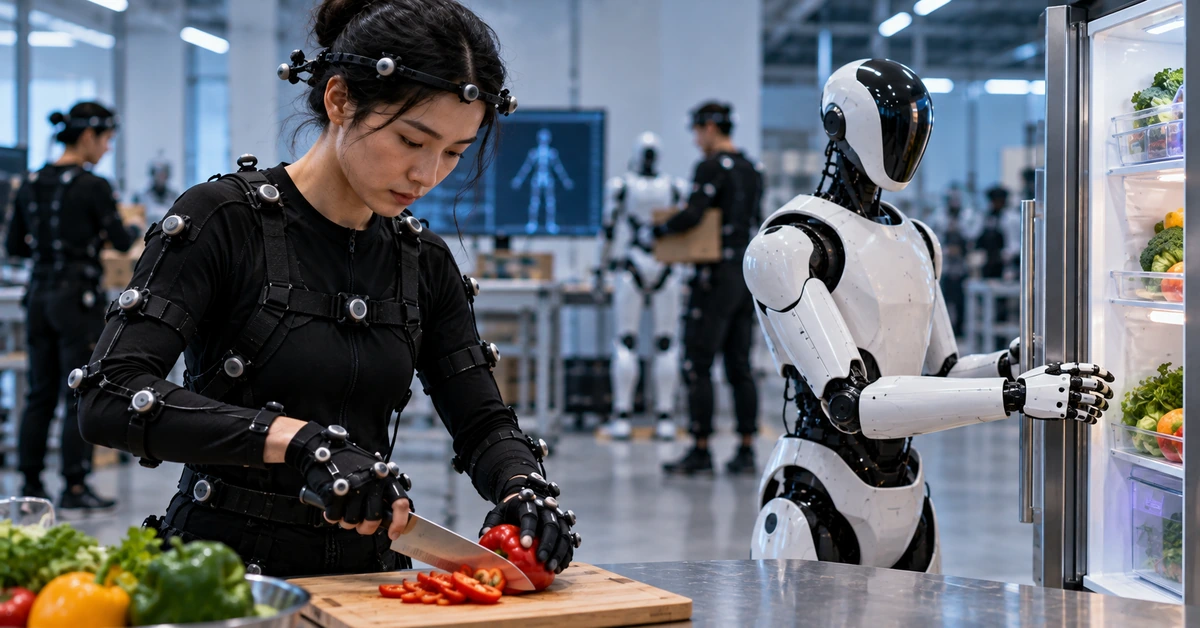
Around 1,000 contractors across China wear data-capture equipment while performing ordinary tasks, according to Reuters.
Reuters observed workers opening refrigerators, unlocking safes and cutting vegetables while wearing sensors designed to record their movements.
That information is then used to train robotic systems to reproduce physical actions.
The approach reflects one of the major challenges facing humanoid robotics.
Modern robots can already walk, manipulate objects and perform some repetitive industrial tasks, but operating reliably in unfamiliar environments requires software capable of understanding instructions, identifying objects and deciding which physical actions to perform next.
Spirit AI is aiming to make that interaction more natural.
Instead of programming individual movements, a user could eventually give a robot an ordinary-language instruction and allow its software to determine the sequence of actions required to complete it.
The company compares the potential development to the capability jump produced by large language models such as GPT, although whether humanoid robotics will achieve a similar breakthrough on Spirit AI’s timetable remains uncertain.
For now, the company is already deploying robots commercially while collecting human movement data at scale.
About 1,000 people are performing everyday physical tasks so the machines can learn how to do them too.
Sources
Join the Dissenting Citizen Newsletter
Independent news and commentary delivered directly to your inbox.
Breaking stories, analysis and commentary throughout the day.
Follow @VoxDissent →