






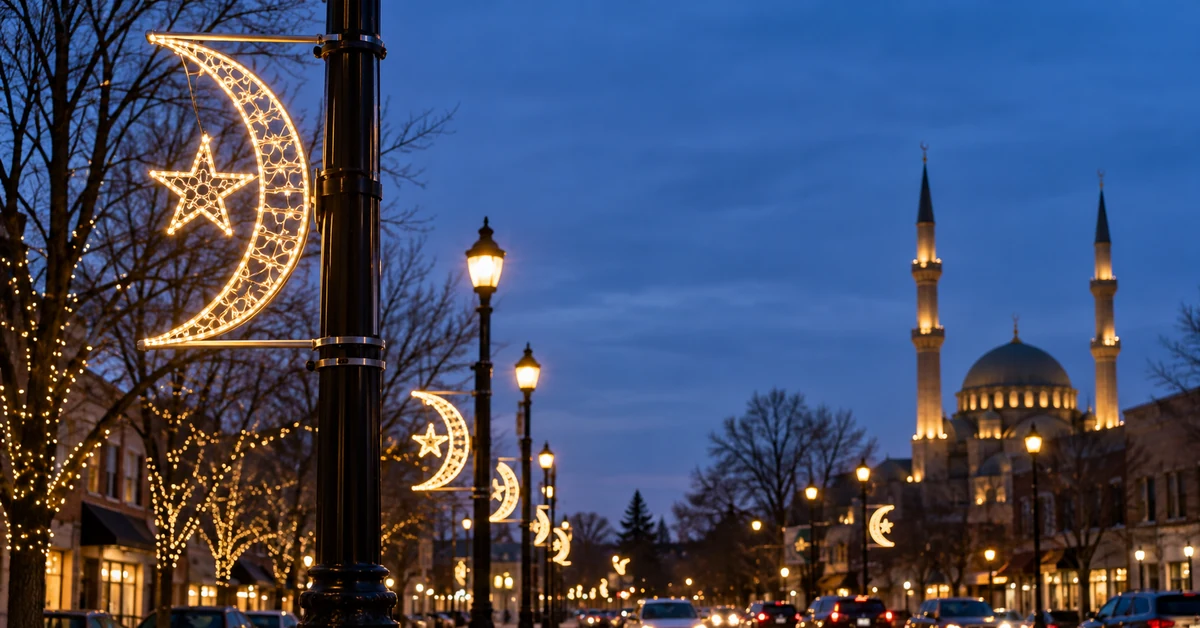
Dearborn has been sued in federal court over claims that the city used public money and property to celebrate Ramadan while failing to respond to requests for similar recognition of Christian and Jewish holidays.
Resident and journalist Margot Cleveland filed the lawsuit against the City of Dearborn and Mayor Abdullah Hammoud on September 17, alleging violations of the First and Fourteenth Amendments. No court has ruled on her claims.
Dearborn also runs programmes associated with other religious and seasonal celebrations. Its programmes have included Easter decorations and city-run winter holiday events featuring public lighting, a Christmas tree, Santa and other seasonal activities.
Cleveland’s complaint instead focuses on the particular support Dearborn provided for Ramadan and what happened when she asked about other religious observances.
She alleges that the city paid for “Ramadan Kareem” banners and a large illuminated crescent in 2025 before introducing crescent-and-star street lighting for Ramadan 2026.
City records show that public money was authorised for Ramadan and holiday lighting. A 2025 budget document included $50,000 for “Ramadan and Holiday lights”, while later meeting minutes authorised a lighting contract worth up to $80,000 from an account called “Ramadan Lighting & Holiday Decoration”.
Those records do not establish that $130,000 was allocated or spent. The material reviewed for this article does not establish whether the two figures overlap, nor how much was ultimately spent specifically on Ramadan displays.
According to the complaint, Cleveland emailed Dearborn’s city attorney in April 2025 asking whether Easter and Passover would receive similar recognition and says she received no response. Her lawyers later raised recognition of Christmas, Easter, Rosh Hashanah and Yom Kippur, with the complaint alleging those communications also went unanswered.
The lawsuit therefore involves something more specific than whether Dearborn acknowledges religions other than Islam. It plainly does.
Cleveland argues that the city’s particular decisions concerning Ramadan, combined with its alleged failure to respond to her requests concerning Christian and Jewish observances, amount to unconstitutional religious preference.
That is her legal argument, not an established finding.
Dearborn’s winter events also mean there is no simple dividing line between government-sponsored Ramadan celebration and private recognition of other traditions. The city itself organises and funds seasonal programming associated with Christmas and the wider winter holiday period.
Did Cleveland ask Dearborn for programmes materially similar to its Ramadan displays? What reasons did the city have for its different programmes? Why, according to the complaint, did officials not respond to her requests? And how much public money was ultimately used for the displays she challenges?
Cleveland’s requested relief includes declarations that the challenged conduct violated her constitutional rights and injunctions against the alleged religious discrimination. Her case does not simply seek an end to municipal recognition of Ramadan.
Dearborn has not yet answered the allegations in court. Any public explanation from the city, together with its eventual legal response, may provide additional context for how it chooses which religious and seasonal programmes to support.
Assessing Cleveland’s allegation will require a clearer understanding of what she requested, what the city provided for different observances, why officials allegedly did not respond and how the relevant programmes were funded.
Sources
- Federal court complaint – Cleveland v. City of Dearborn
- American Freedom Law Center – lawsuit announcement
- City of Dearborn – Spring Aglow programme
- City of Dearborn – winter holiday programming
- City of Dearborn – Warren BDIA minutes
Join the Dissenting Citizen Newsletter
Independent news and commentary delivered directly to your inbox.
Breaking stories, analysis and commentary throughout the day.
Follow @VoxDissent →